
100% Stocks and the 90/60 Portfolio
What happens when the theoretically better portfolio is more complicated and harder to stick with?
Let’s say you are young, your time horizon is long, you are comfortable with volatility, and you want to hold 100% of your portfolio in equities (diversified index funds). You accept that you will likely see dramatic downturns over the course of your holding period, but you know that’s the price you must pay to have a good chance of earning a healthy real return over inflation in the long run.
A certain corner of the academic world and financial industry will come to you and say, aha! Your goal in investing should be to maximize your expected return for a given amount of risk. I have a portfolio with a higher expected return and the same amount of risk! You are violating one of the principles of investing, and you should switch to my strategy!
It turns out, they have a decent point. But, it’s complicated.
What is the 90/60 portfolio?
Their portfolio is the levered 60/40 portfolio, aka a 90/60 portfolio. It starts with a standard 60% stock / 40% bonds allocation, then uses 1.5 times leverage to achieve 90% equity exposure and 60% fixed income exposure. This means that for every $100 you invest, you borrow $50 against it, and with your $150 you then buy $90 worth of stocks and $60 worth of bonds. (It’s a bit more complicated in practice, but this is the core idea.)
A famous 1996 paper lays out the comparison. Here is the key table from that paper:
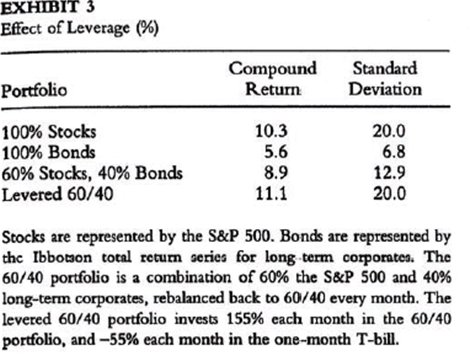
Source: Cliff Asness, “Why not 100% Equities,” The Journal of Portfolio Management, 1996; via WisdomTree 2018 blog post “Research on a Levered 60/40 Approach vs. 100% Equities”. Research conducted with data from 1/31/1926 through 12/31/1993.
As you can see, in this particular historical period, the levered 60/40 approach (approximately a 90/60 portfolio) has the same volatility as the 100% stock portfolio, as measured by standard deviation, but returns 11.1% annually rather than 10.3%. In other words, you got better returns for the same volatility.
So if I show you the two portfolios in a vacuum, which do you pick?
Portfolio A: 20% standard deviation, 10.3% annual returns
Portfolio B: 20% standard deviation, 11.1% annual returns
Of course you pick Portfolio B. You get higher returns for the same volatility, so it’s the only logical answer.
But, we don’t live in a vacuum.
What else matters besides standard deviation and expected returns?
It is very reasonable to solve for maximizing expected return for a given level of risk. I support that goal. However, in this case I think the outcome can conflict with two other foundational principles of investing:
1. Simplicity over complexity. Do I understand what I own and why it works?
Portfolio A is a basket of global stocks. You own companies around the world. Period, end of story.
Portfolio B is a levered 60/40 portfolio to achieve 90% stock and 60% bond exposure. This was harder to do a decade ago, but today one reasonable way to do this is with the NTSX ETF from WisdomTree. Except the stocks are only the S&P 500, so we’ll have to mix in some other ETFs to get global exposure. Oh and technically it’s actually 90% stocks and then 10% 6x U.S. treasury futures contracts, so the bond side of things is implemented a bit differently than in the 1996 study.
Which one wins on simplicity? Portfolio A
2. The best portfolio is the one you can stick with. Can I maintain my conviction when it doesn't work?
If the market gets crushed and you own all stocks, it is a brutal feeling. Let’s say you’ve watched 40% of your portfolio evaporate. Not a good feeling! The only silver lining is, you have decades of market history to look back on and hundreds of books to read to put it in context. It may not be easy to maintain your buy-and-hold strategy in the face of steep declines, but at least there is an enormous body of evidence and experience supporting the decision to simply keep owning stocks.
Now imagine you’re down 40% in your levered 90/60 portfolio. Still not a good feeling! Only now, you’re a bit more on your own. There’s going to be a lot fewer people preaching to stay the course in your levered 90/60 portfolio. That’s not because it’s necessarily a bad strategy. But the less familiar your portfolio, the harder it will be to justify to yourself why you own it during a crash.
The point isn’t just that you’ll feel better with Portfolio A. It’s that you may be more likely to stick with it during the downturns, which is the whole key to unlocking the positive long-term returns.
Which one is easier to stick with? Portfolio A
Making a choice
Owning 100% stocks is a devil. You’re setting yourself up for big drawdowns. You know you will experience pain. But you might accept it because you know the long-run outcomes are likely to be good. (Or you might not… perfectly reasonable, let’s get you some bonds to go along, with no leverage!) It’s the devil you know.
Owning a 90/60 portfolio is also a devil. You’ll still get the big drawdowns. Theoretically, you should earn a bit more return for your pain than 100% stocks, so this devil looks a bit nicer. But it’s also more complicated. It could be harder to stick with. It’s the devil you don’t know (... or know less well)
Which to go with? There’s no answer that’s right for everyone. Risk-adjusted returns matter, but so do simplicity and conviction. Personally, I’d go with the devil I know, and I’d take the simple basket of stocks. I might not be making the optimal choice on paper, but for me it’s the right choice in the real world.
The information provided is for educational and informational purposes only and does not constitute investment advice and it should not be relied on as such. It should not be considered a solicitation to buy or an offer to sell a security. It does not take into account any investor's particular investment objectives, strategies, tax status or investment horizon. You should consult your attorney or tax advisor.
The views expressed in this commentary are subject to change based on market and other conditions. These documents may contain certain statements that may be deemed forward looking statements. Please note that any such statements are not guarantees of any future performance and actual results or developments may differ materially from those projected. Any projections, market outlooks, or estimates are based upon certain assumptions and should not be construed as indicative of actual events that will occur.
